- AI Contribution is an experiment paying publishers for content cited in AI Overviews
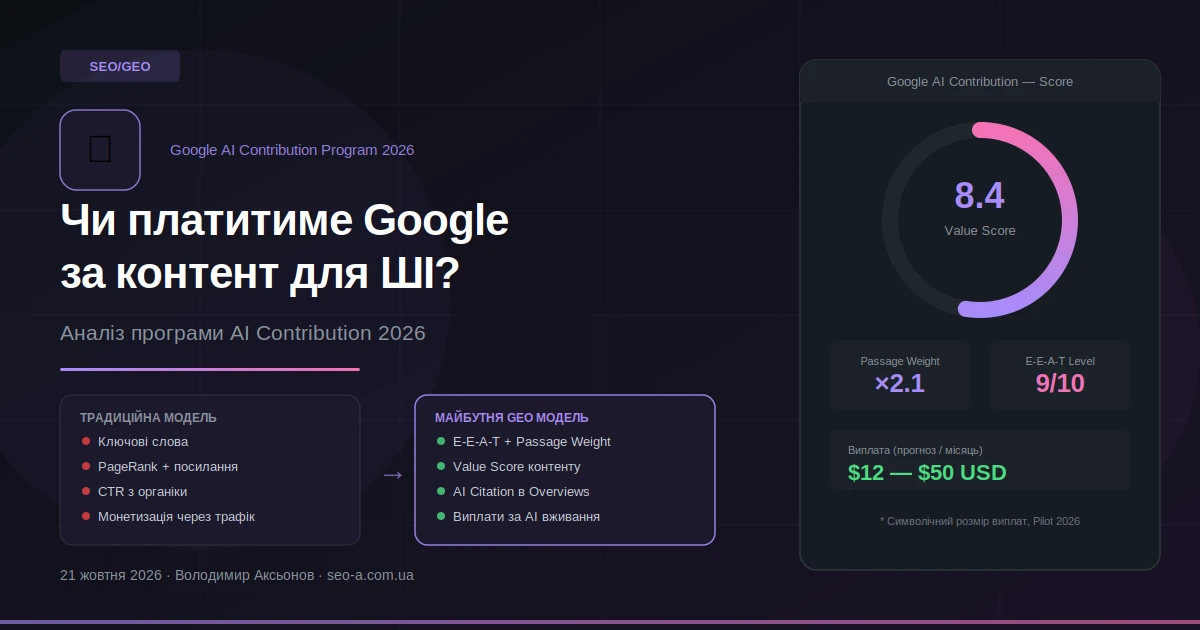
- Payments are based on three metrics: factual accuracy, content weight, and E-E-A-T
- This does not replace advertising revenue but becomes an additional channel
- Sites with structured content and strong authorship have an advantage
The AI Overviews era reshaped the economics of search. Dozens of publishers report traffic drops of 15–40% on informational queries. Google's response arrived in a format few expected: the AI Contribution program — an experiment in which the company pays publishers whose content ends up in generative blocks.
Let's break down what is actually known about this program, what criteria the system evaluates, and how to position your site to participate.
1. What is the AI Contribution Experiment?
AI Contribution is a Google experiment in which the company rewards publishers whose materials are regularly cited in AI Overviews. Conceptually, it represents a shift from the traditional model where traffic is the measure of value — to a model where being a knowledge source for an LLM becomes a monetizable asset in itself.
According to reports from Search Engine Journal and BrightEdge, Google evaluates three core dimensions when selecting participants:
Factual Accuracy
The system prioritizes pages where information can be cross-verified with authoritative sources. Outdated data, factual errors, and unsubstantiated claims dramatically reduce the probability of being cited.
Content Weight
This is not about word count. It's about the depth and structure of the material: does the content cover the topic from multiple angles, does it contain original observations (not just a retelling of existing sources), and does the structure allow the model to extract a specific answer to a user's question.
E-E-A-T
Experience, Expertise, Authoritativeness, Trustworthiness — now with even more weight. Having verified authors with biography pages, brand mentions in industry publications, and active citation of your materials by other sites are all factors that increase the likelihood of being selected for the AI Contribution experiment.

2. Symbolic or Real Compensation?
The key question for publishers: is this a marketing move or genuine monetization?
Based on early reports, payment amounts depend on citation frequency in generative blocks and the category of queries. Niches with high commercial intent (finance, medicine, law, technology) show significantly higher payout rates than general-interest content.
Importantly: this does not replace advertising revenue. In the experiment phase, it's an additional channel. However, given that AI Overviews continues to reduce classic CTR, AI Contribution can partially compensate publishers for lost traffic.
We'll audit your content for GEO compliance and build a strategy for getting cited in AI Overviews.
3. How to Prepare Your Site for AI Contribution
There is no official waitlist yet. But preparing now means being ready when the program expands:
- Factual verification: review all key materials — update statistics, add source links, remove outdated claims.
- Structure: add H2/H3, tables with comparisons, FAQ sections. LLMs extract information most easily from structured content.
- Author pages: create dedicated pages for each author with biography, expertise areas, and links to key publications.
- Schema markup: implement
Article,Person,FAQPageschemas — they help the model understand who authored the content and what questions it answers. - Brand mentions: actively work on getting your site mentioned in industry media, podcasts, and discussions.
Summary
AI Contribution represents the first clear signal that Google understands: you can't build an AI search engine on top of publishers' content without some form of reciprocal value. Whether this becomes a full-fledged industry standard or remains a niche experiment will become clear in 2027. For now, the best strategy is building content that meets the criteria, regardless of the program's outcome — because these same factors drive visibility in AI Overviews in general.