- AI Overviews appear in 25–50% of queries — and this share keeps growing
- 26% of users end their search session without clicking any organic result
- Only 37.9% of AI Overview citations come from the classic top-10 results
- GEO requires shifting from keyword density to structured, direct answers
- Brands absent from third-party media have far lower chances of being cited
The New Search Reality
For a long time, the main goal of organic optimization was straightforward: reach position one in Google and capture the largest share of traffic. But the emergence and wide rollout of AI Overview answer blocks (formerly SGE) has fundamentally changed user behavior and how clicks are distributed across search results.
A high organic ranking still matters — but it is no longer the sole or decisive criterion for capturing a potential customer's attention. Let's break down exactly what algorithmic shifts are happening right now and how businesses and SEO professionals can adapt their content strategy to the new reality of GEO (Generative Engine Optimization).
AI Overviews in Numbers: What the Latest Research Shows
Analytics platforms paint a clear picture of where generative search is heading. Three key studies provide a full view of what is happening:
BrightEdge: Scale of AI Overviews Coverage
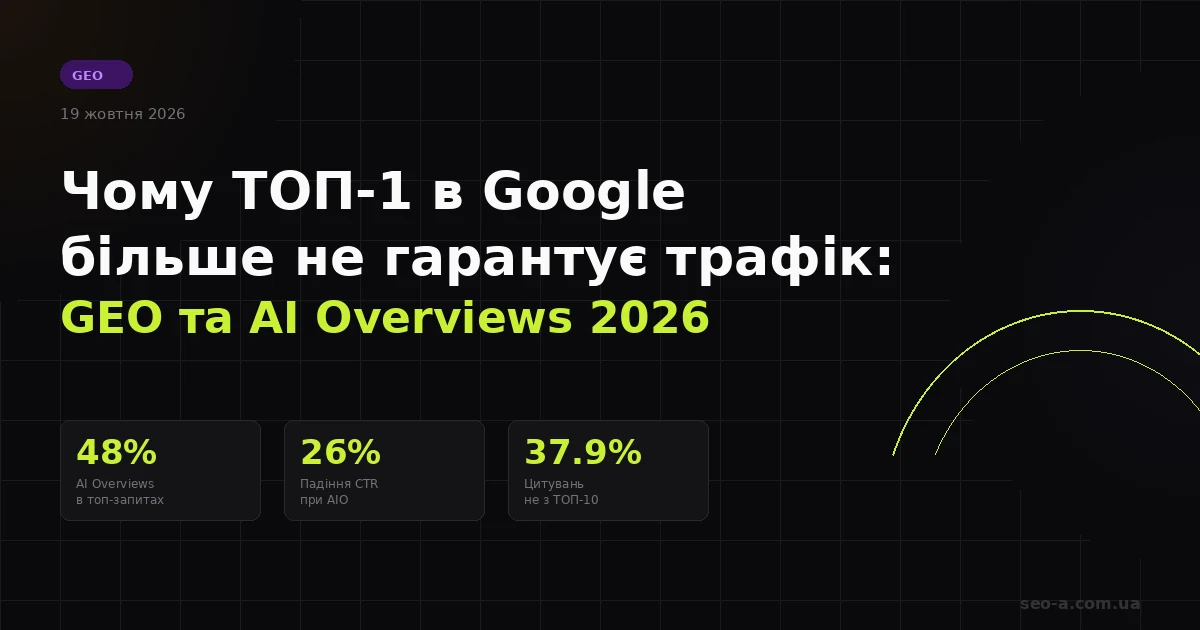
According to BrightEdge's AI Overviews research, generative answer blocks now appear in 25–30% of all search queries across the US and Europe. For complex informational and long-tail queries, the figure exceeds 48–50%. The highest coverage is observed in B2B, technology, education, and healthcare verticals.
Pew Research: User Behavior Has Shifted
Pew Research Center's study, as analyzed by ODSC, found that when a generative block appears on the results page, around 26% of users end their search session having received a complete answer directly in the SERP (Zero-Click Search). This means a quarter of your potential audience no longer visits any website from organic results — even if your site holds the #1 position.

Ahrefs: Where AI Overview Citations Actually Come From
Ahrefs' research on AI Overview citation sources reveals a critical pattern: only about 37.9% of links inside AI Overview blocks originate from the classic top-10 organic results. The remaining citations are pulled from positions 11–100 or from specialized knowledge sources — whenever their content provides a more precise answer to a specific sub-question within the query.
Why AI Cites Sites Outside the Top 10
To build an effective content strategy, it is essential to understand how the language models embedded in search actually work. When a user enters a complex or long-tail query, Google's generative system performs what is known as Query Fan-Out — it breaks a single query into a series of micro-queries and finds precise answers for each one independently.
If your site ranks 14th overall but contains the clearest, most concise, and best-structured explanation of a narrow aspect of the topic — the algorithm will very likely choose your passage for citation in the AI Overview. This is fundamentally different from the logic of classical SEO, where ranking position is the deciding factor.
We'll run a GEO audit and identify which pages have citation potential in AI Overviews.
Practical Checklist: How to Optimize Content for GEO
Getting cited by generative systems requires more than the traditional approach of "keyword density." The entire way you structure information needs to change.
The Answer-First Principle
Place a direct, concise answer to the page's main question right at the top — in the first or second paragraph, or immediately below the H2 heading. Then expand with details, arguments, and examples. AI systems look for ready-made passages (Passage Extraction) that can be embedded in a response without additional processing.
- Write H2 headings as questions or clear declarative statements
- First paragraph after H2 — a direct 2–3 sentence answer
- Details, nuances, and examples follow in subsequent paragraphs
- Add a FAQ section at the end of every article
Semantic Coverage and Entities
Instead of targeting a single keyword, cover the full semantic cluster around your topic. Use lists, comparison tables, and FAQ formats. The clearer the internal logic of your text, the easier it is for a language model to parse it and extract a relevant passage.
- Cover the entire semantic cluster of the topic, not just one keyword
- Add comparison tables for structured data
- Mark up content with Schema.org (FAQ, HowTo, Article)
- Use explicit definitions in the format "X is..."
E-E-A-T and Third-Party Proof
AI models evaluate not only the text on your website, but also how your brand is mentioned across external platforms. Off-site authority signals are becoming critical for GEO:
- Articles and expert commentary on industry publications
- Mentions and discussions on topical platforms (Reddit, Quora)
- YouTube video content (actively cited in generative answer blocks)
- Podcasts and interviews featuring named authors
How to Measure GEO Performance
Since traditional Organic CTR is now distorted by AI Overviews, measuring effectiveness requires new metrics alongside the old ones:
- Google Search Console: impressions and clicks for informational queries; watch for a growing gap between impressions and clicks — this often signals Zero-Click capture by AI Overviews
- Share of Model Mentions: regularly check whether your brand or content appears in responses from ChatGPT, Perplexity, and Gemini for key queries in your niche
- Referral traffic from AI platforms: monitor sessions from Perplexity, Bing Copilot, and ChatGPT in your analytics dashboard
Conclusion
GEO (Generative Engine Optimization) is not a replacement for classical SEO — it is SEO's logical evolutionary next step. Technical optimization, backlinks, and domain authority remain the foundation. GEO adds a new layer of work: structuring content for generative search, applying the Answer-First principle, and actively building an authoritative external presence.
Sites that produce deep, well-structured content with clear answers and have established topical authority gain new opportunities to reach their audience — even without holding the #1 organic position.