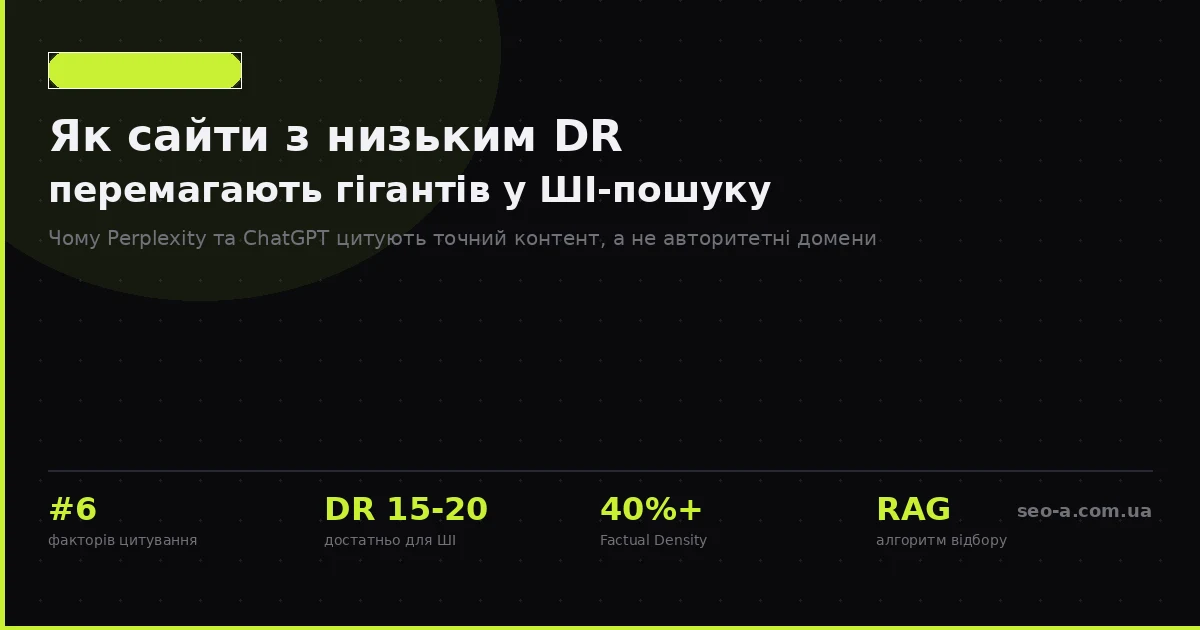
- RAG systems select the most accurate knowledge passage, not the most authoritative domain
- Factual Density, Entity Matching, and no filler intro are the three core citation factors
- A site with DR 15–20 can beat a giant if it answers the question in the first 40 words
- Third-Party Proof multiplies algorithmic trust in your facts
- Citation Frequency replaces rankings as the primary KPI for the GEO channel
For years, classic SEO ran on an unwritten rule: to reach the top 3 for a competitive query, you needed a strong Domain Rating. Sites with DR 15–20 were left competing for low-volume long-tail phrases.
But as audiences migrated to Perplexity AI and ChatGPT Search, that monopoly started cracking. It's now routine to see an AI assistant cite a small niche blog — while completely ignoring content from DR 80+ portals covering the same topic. This isn't a bug. It's a consequence of fundamentally different source-selection mechanics.
1. Accuracy over authority: how AI search selects sources
Classic Google looks for the most authoritative page to surface in a results list. AI search solves a different problem: finding the most accurate knowledge passage to build a coherent answer. The technology behind this is Retrieval-Augmented Generation (RAG).
A RAG algorithm doesn't rank pages as units. It splits indexed content into passage chunks and retrieves the one that best matches the query. If your passage hits — it ends up in the answer, regardless of the domain's overall DR.
In this context, three parameters become decisive:
Factual Density — facts per paragraph
This is the count of real numbers, concrete actions, and verified data per paragraph. Compare two answers to the query "what's the average cost of link building for B2B SaaS":
| Low Factual Density | High Factual Density |
|---|---|
| Link building costs depend on many factors and can vary significantly based on strategy and competition in the niche. | Median link-building budget for B2B SaaS in 2026: $2,000–$5,000/month. Guest posts on DR 50+ sites: $300–$700 per link. Digital PR campaign reaching 10+ media outlets: from $3,000. |
The RAG system extracts the second version because it provides a ready-made answer passage — it doesn't need additional context parsing.
No filler intro
If the answer to the reader's question starts on the third scroll — after a long intro, a "why this matters" section, and three paragraphs about the company — the algorithm either won't reach the substance or will find a cleaner answer elsewhere.
Practical rule: the answer to the headline question must start within the first 40–60 words of the article body. Context and background come after the point, not before it.
Entity Matching — explicit relationships between concepts
Text must explain the relationships between entities without ambiguity. "It" and "they" instead of concrete names is a classic mistake that breaks Entity Matching. The algorithm needs to understand: who did what, with what result, in what context.

2. Anatomy of a text that gets cited
Large media outlets often publish long-reads with drawn-out intros and vague conclusions. For a language model, that's noise — hard to extract a clean passage from.
To get the algorithm to pull your fragment into an answer, build each content block with this structure:
- H2/H3 as a direct question or explicit topic. For example: "What image dimensions does AI Overviews require?" — not "Images and AI."
- First sentence — direct answer in 40–50 words. The point, no preamble.
- Detail in the form of a bulleted list or comparison table. Not a wall of text — a structure a bot-scanner reads in a single pass.
This structure lets PerplexityBot and OpenAI WebSearchBot read a ready knowledge block without additional interpretation. The less the model has to infer, the higher the probability of accurate citation.
We'll check Factual Density and Entity Matching on your actual pages and give you a step-by-step fix plan.
3. External consensus: why Third-Party Proof beats link building for GEO
LLM systems don't just find an answer — they verify it for credibility through cross-referencing. If a fact published on your site is independently confirmed in discussions on Reddit, Quora, or industry media, the system assigns it a higher credibility rating.
The logic is straightforward: if three independent sources say the same thing, the probability of error is lower than when the fact exists in only one place.
This leads to a practical GEO strategy conclusion: brand presence and the specific claims from your content appearing on third-party platforms produces significantly more AI-citation impact than standard link acquisition.
Concrete steps for Third-Party Proof:
- Publish specific data and case studies — not just opinions. Facts spread and get cited; opinions do so far less.
- Contribute to relevant Reddit threads and Quora questions — not as promotion, but with actual data.
- Co-publish with industry media or podcasts — even a native mention with your specific quote creates a cross-reference point.
Key takeaways for your SEO/GEO strategy
Budgets are shifting toward content structuring. Link building remains important for classic Google, but what determines AI-search visibility is editorial quality and factual density. Expensive link campaigns don't substitute for a concrete answer in the first paragraph.
Citation Frequency is the new KPI. Alongside standard rank tracking in Search Console, add monitoring for how often your brand or URL is cited in ChatGPT, Perplexity, and Gemini for target queries. Track it manually or via AI-mention monitoring tools.
The template-rewrite era is over. Surface-level paraphrasing of the first SERP page without original data is a dead format for GEO. If a piece contains no unique data slice or firsthand experience, AI systems will ignore it in favor of a source with real numbers.