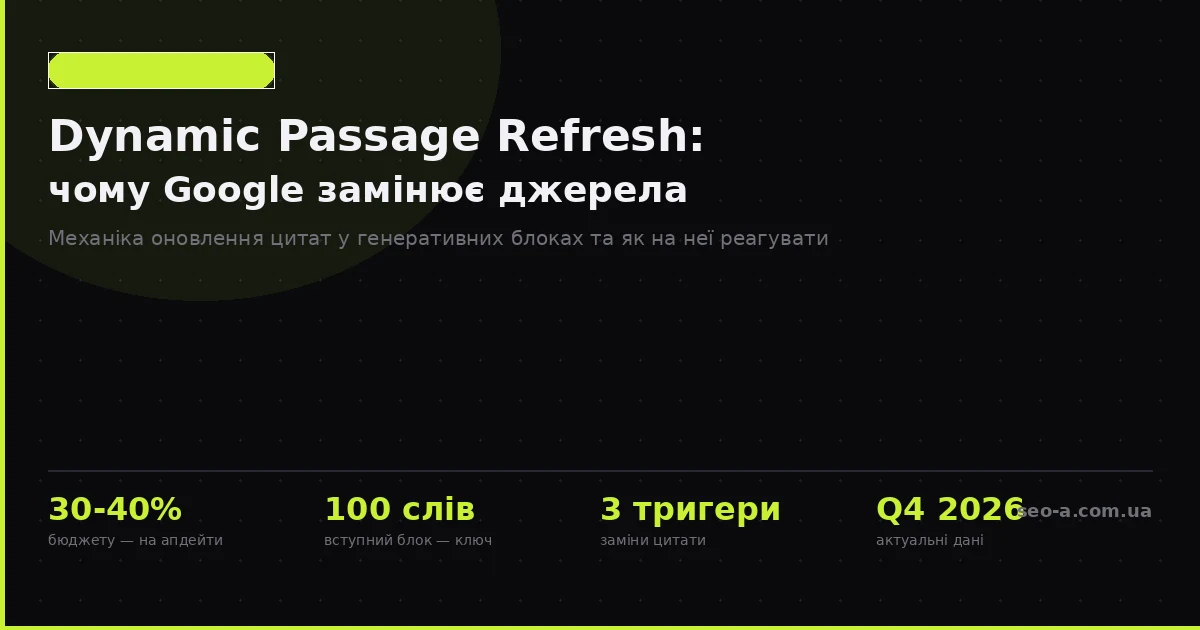
- Dynamic Passage Refresh is the mechanism by which Google replaces sources in AI Overviews in real time
- Three replacement triggers: updated statistics, temporal context shift, and better data structure
- Changing only the publication date without updating content is useless for LLMs
- First to publish structured data on a new niche event wins a temporary citation monopoly
- In GEO, 30–40% of team time should go to updating existing content, not creating new
Classic SEO ran on inertia. A page that broke into the top 3 for a high-volume query — and had solid behavioral metrics — could hold its position for months without a single edit.
AI Overviews changed that contract. Google introduced Dynamic Passage Refresh: a mechanism that dynamically replaces content passages inside a generative block, so sources within an AI Overview can rotate much faster than traditional rankings do.
Let's break down exactly what forces the algorithm to replace a citation — and how to set up a system that keeps your pages in the AI answer.
What is Dynamic Passage Refresh
Traditional Googlebot recrawls a page and reassesses its position in search results based on link profile, behavioral signals, and content relevance. The Dynamic Passage Refresh layer works at a different level: it evaluates the factual freshness of a content fragment relative to competing fragments covering the same topic.
The result: a page that was cited in an AI Overview last week may be replaced today — not because it lost positions in classical SERP, but because a competing page delivered a more current or better-structured answer to the same question.
Triggers that cause replacement in AI Overviews
Based on monitoring data from Keywords Everywhere and Semrush, three conditions consistently trigger a citation swap in the generative block:
Updated statistics appear in the niche
When a fresh industry report or new figures are published, the algorithm favors the page that incorporates that data first. A page with 2024 benchmarks that hasn't been updated loses to a page that added 2026 figures — even if the outdated page holds a stronger domain authority.
Practical implication: set up a monitoring alert for your key topics. When new research drops, update the relevant section within 24–48 hours — before your competitors do.
Temporal context shift
When a significant new event occurs in a topic area — a regulation change, a major platform update, a market shift — the generative block rebuilds itself. Static "evergreen" reference articles that don't mention the event get filtered out; pages that frame their content in relation to the new situation move in.
This is why a timeless article written in 2023 can lose its AI Overview slot overnight after a major update lands, despite years of stable rankings.
Better data structure
If a competitor reformats the same information into a comparison table or a clean bulleted list, the AI system may replace your citation — even if your article was published earlier and has more backlinks. The passage extraction logic favors content that delivers a ready-made, machine-readable answer block.
Check your existing citations quarterly: if a competitor just redesigned their content around tables and lists, your slot is at risk.

Why changing the date no longer works
There's a dated SEO trick — update the year in the H1 heading and set a new dateModified in Schema.org markup, without touching the actual body text. It boosted freshness signals in classic ranking algorithms. For language models, it's completely ineffective.
An LLM compares content vectors between the previous and current versions of a page. If the semantic content hasn't changed — no new facts, no rewritten paragraphs, no fresh sources — the algorithm ignores the technical timestamp and does not reassess the page's status in the generative block.
The model distinguishes cosmetic date changes from substantive updates. The only thing that counts is a measurable shift in information content.
We'll identify which pages are at risk of losing citations and build a prioritized update roadmap.
Content update checklist for GEO
To keep pages in AI Overviews citations, use this update protocol:
6-step update protocol
Key takeaways for your GEO strategy
The shift from creation to maintenance. If 80% of SEO team time historically went to new articles, in GEO 30–40% of resources should be redirected to systematically updating the existing content core. A page that has held an AI Overview citation for two months without an update is already at risk.
Reaction speed as a competitive advantage. The site that first publishes a structured answer to a new niche development gets a temporary citation monopoly in AI Overviews. Configure Google Alerts or industry tracker feeds for your key topic areas — and build a workflow that lets you update priority pages within 24 hours of a relevant development.
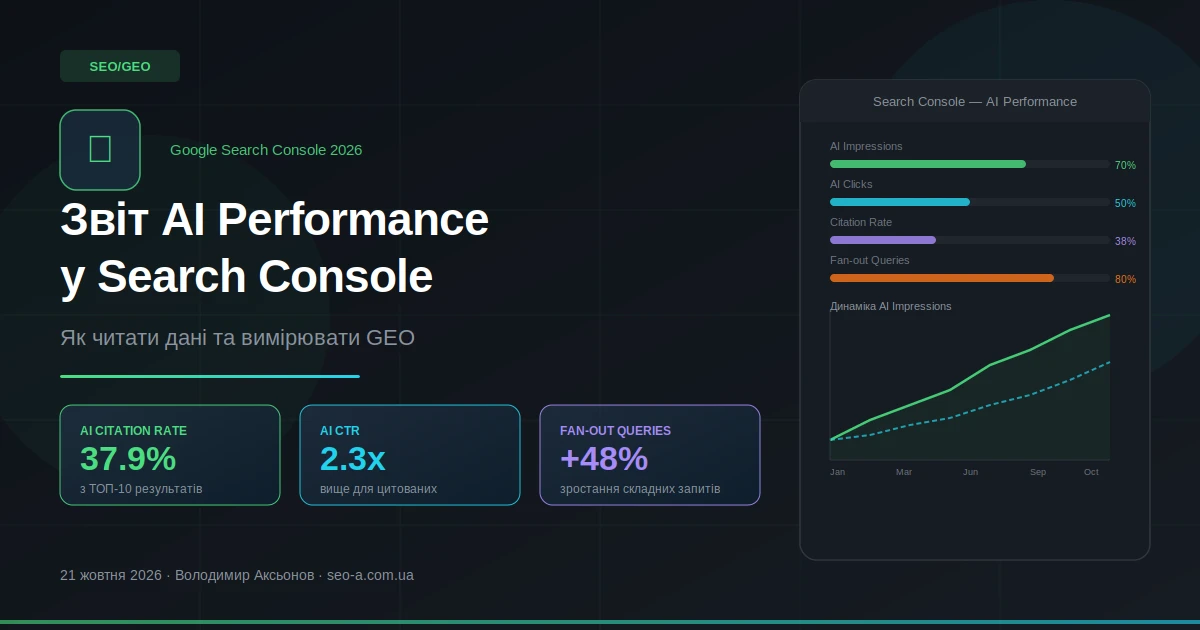
Monitor GSC AI Performance. As soon as impressions begin dropping in the AI Performance report in Search Console, that page needs substantive, factual updating — not new backlinks. A drop in AI Overview impressions is a signal to look at content freshness, not link profile.